
School Academic Programs
THE SCHOOL FOLLOWS THE COMMON CORE STANDARDS (CCS)
Rand Schools for Education offers a dual curriculum model across two distinct sections. The International Section and the Al-Ahliya Section. The International Section currently serving grades K–9, is built around globally benchmarked academic standards including the Common Core State Standards (CCSS) for English Language Arts and Mathematics, and the Next Generation Science Standards (NGSS) for Science. The Al-Ahliya Section (grades 3–6), focused on Arabic curriculum as well as supported with CCSS-English, licensed by the Saudi Ministry of Education, serves exclusively for girls.
The Early Learners – Kindergarten of International section, comprising Pre-K through KG3 focuses on nurturing children’s development in social, emotional, physical, and cognitive domains. Learning at this stage is play-based and exploratory, laying the foundation for future academic success while encouraging curiosity and engagement.
In elementary and middle school (grades 1–9) of International section, students engage with American curriculum based textbooks across the core subjects—English, Math, Science along with Social Studies, Financial Literacy and Specials’ subjects like Visual Arts, Drama, PE, Coding and Engineering, and ICT from varied publishers that aligns with school’s standards and curriculum framework, as well as Ministry-required courses such as Arabic and Islamic Studies. Teachers use a constructivist approach, creating a safe and dynamic classroom where inquiry, critical thinking, and collaborative learning flourish. Students are continuously assessed through quizzes, projects, and class participation engaged in varied strategies of formative and summative assessments allowing teachers to identify the needs and help students for success.
Rand Schools are accredited by Cognia (formerly AdvancED), and authorized to implement the International Baccalaureate Primary Years Programme (IB-PYP)—a significant step under the Kingdom’s KFF/IB Project. The PYP encourages students aged 3 to 12 to become active, independent learners through inquiry and exploration. It uses a transdisciplinary framework focused on globally significant themes and the IB Learner Profile, promoting reflective thinking, open-mindedness, and international-mindedness.
To build on the PYP foundation, Rand Schools continues to implement the IB Middle Years Programme (MYP) for students aged 11 to 16. The MYP provides a rigorous academic structure integrating global contexts, real-world applications, and interdisciplinary learning. It empowers students to engage thoughtfully with complex topics, culminating in a Personal Project that showcases their research, creativity, and individual growth.
With these international programs, Rand Schools prepare students to meet global challenges preparing the lifelong learners. As part of its strategic expansion, the school will add one grade level each consecutive year until reaching Grade 12. The school aims to implement the full IB continuum: Primary Years Programme (PYP), Middle Years Programme (MYP), Diploma Programme (DP), and Career-related Programme (CP).
AMONG ALL THE SCHOOLS IN SAUDI ARABIA,
18 were selected for KFF/IB Project (Developing learners, leaders, and teachers for the future of the kingdom of Saudi Arabia) and with pleasure, Rand Schools Group was one of them.
Rand Schools, a leading international school, is proudly recognized among the prestigious IB (International Baccalaureate) World Schools as one of only 23 IB-PYP (Primary Years Programme) authorized schools in Saudi Arabia and one of only 6 in the Eastern Region. Building on its achievements, being both Cognia-accredited and IB-PYP authorized, Rand Schools is committed to expanding its IB programmes to include the Middle Years Programme (MYP) and Diploma Programme (DP) for grades up to 12 in the coming years.
It is carefully designed to provide a rich and challenging education that fosters active and self-directed learning, empowering students to take charge of their learning journey and achieve excellence, growing into skillful, confident, compassionate, and responsible future-ready individuals.
By this spirited step, we will be connected locally and internationally with the family of IB world schools.
about IB
Founded in 1968, the International Baccalaureate® (IB) is a non-profit educational foundation offering four highly respected programs of international education (PYP,MYP,DP,CP) that develop the intellectual, personal, emotional and social skills needed to live, learn and work in a rapidly globalizing world.
Teaching and learning in the IB celebrates the many ways people work together to construct meaning and make sense of the world. Through the interplay of asking, doing and thinking, this constructivist approach leads towards open, democratic classrooms.
PYP will ensure that the school, students, and parents move together in a rewarding and rich learning journey that will allow all learners to express and discover themselves within the IB LEARNER PROFILE.
IB LEARNER PROFILE:

Inquirer
We nurture our curiosity, developing skills for inquiry and research. We know how to learn independently and with others. We learn with enthusiasm and sustain our love of learning throughout life.

Communicators
We express ourselves confidently and creatively in more than one language and in many ways. We collaborate effectively, listening carefully to the perspectives of other individuals and groups

Thinkers
We use critical and creative thinking skills to analyse and take responsible action on complex problems. We exercise initiative in making reasoned, ethical decisions.

Knowledgeable
We develop and use conceptual understanding, exploring knowledge across a range of disciplines. We engage with issues and ideas that have local and global significance.

Principled
We act with integrity and honesty, with a strong sense of fairness and justice, and with respect for the dignity and rights of people everywhere. We take responsibility for our actions and their consequences.

Reflective
We thoughtfully consider the world and our own ideas and experience. We work to understand our strengths and weaknesses in order to support our learning and personal development.

Balanced
We understand the importance of balancing different aspects of our lives-intellectual, physical, and emotional-to achieve well-being for ourselves and others. We recognize our interdependence with other people and with the world in which we live.

Open-minded
We critically appreciate our own cultures and personal histories, as well as the values and traditions of others. We seek and evaluate a range of points of view, and we are willing to grow from the experience.

Risk-takers
We approach uncertainty with forethought and determination; we work independently and cooperatively to explore new ideas and innovative strategies. We are resourceful and resilient in the face of challenges and change.

Caring
We show empathy, compassion and respect. We have a commitment to service, and we act to make a positive difference in the lives of others and in the world around us.
Primary Years Programme..
The Primary Years Programme is a curriculum framework from the International Baccalaureate offered to students from ages 3-12. Students who go through the Primary Years Programme, or PYP, become self-motivated inquirers and internationally-minded members of their communities.
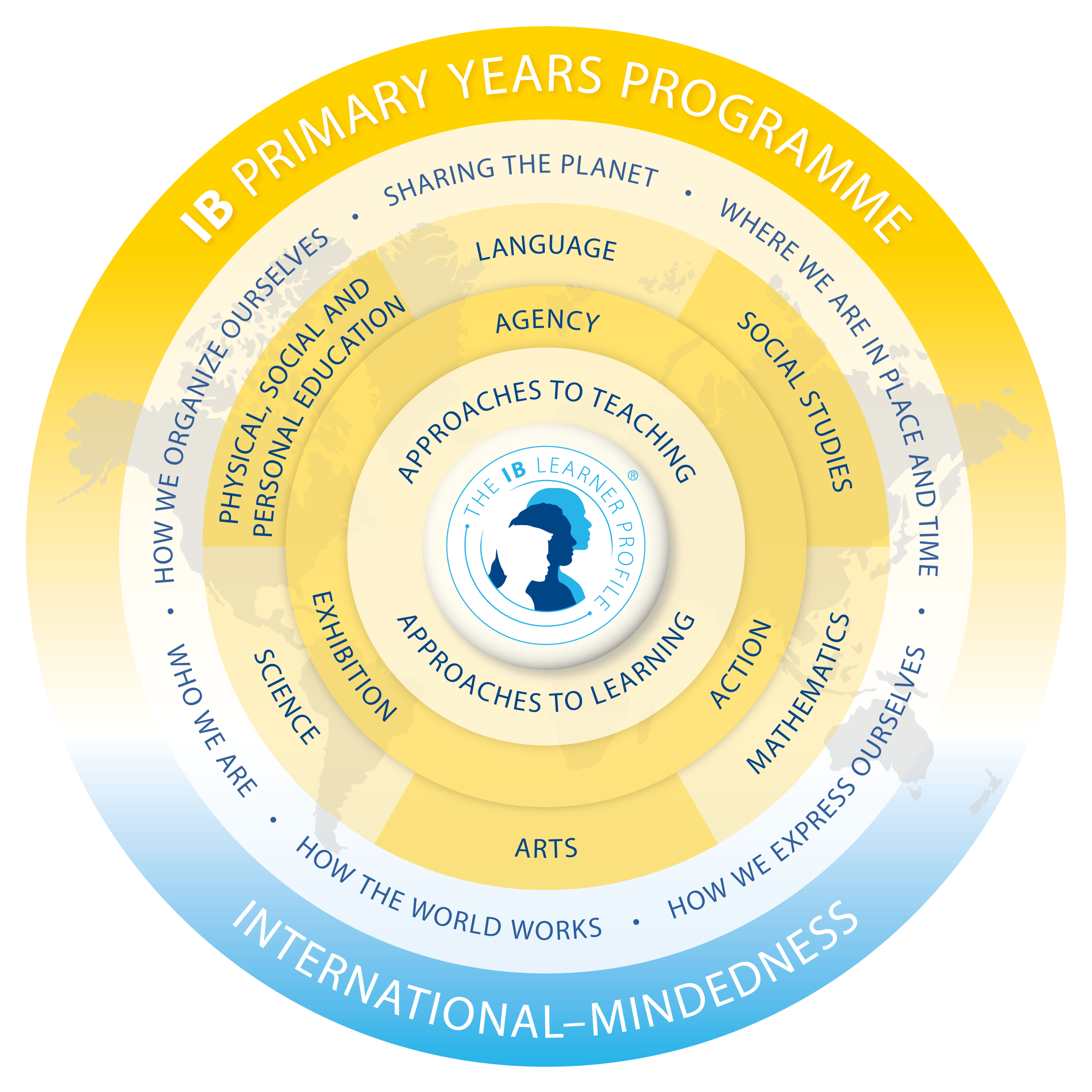
“The International Baccalaureate aims to develop inquiring, knowledgeable and caring young people who help to create a better and more peaceful world through intercultural understanding and respect.”
How We Are
An inquiry into the nature of the self; beliefs and values; personal, physical, mental, social and spiritual health; human relationships including families, friends, communities, and cultures; rights and responsibilities; what it means to be human.
Where We Are in Place and Time
An inquiry into orientation in place and time; personal histories; homes and journeys; the discoveries, explorations and migrations of humankind; the relationships between and the interconnectedness of individuals and civilizations, from local and global perspectives.
How We Express Ourselves
An inquiry into the ways in which we discover and express ideas, feelings, nature, culture, beliefs and values; the ways in which we reflect on, extend and enjoy our creativity; our appreciation of the aesthetic.
How The World Works
An inquiry into the natural world and its laws; the interaction between the natural world (physical and biological) and human societies; how humans use their understanding of scientific principles; the impact of scientific and technological advances on society and on the environment..
How We Organize Ourselves
An inquiry into the interconnectedness of human-made systems and communities; the structure and function of organizations; societal decision-making; economic activities and their impact on humankind and the environment.
Sharing The Planet
An inquiry into rights and responsibilities in the struggle to share finite resources with other people and with other living things; communities and the relationships within and between them; access to equal opportunities; peace and conflict resolution.